

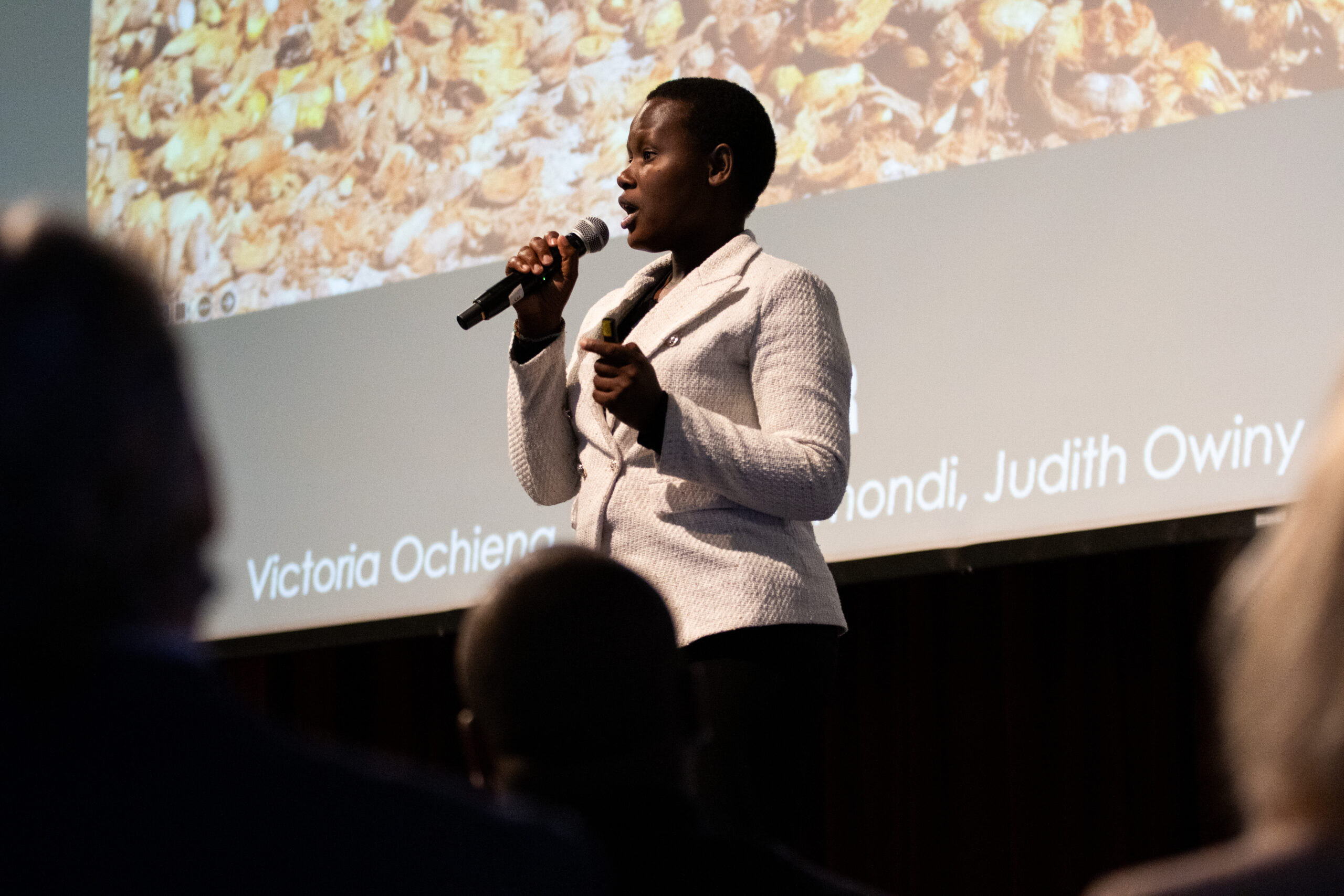
Innovative venture “Koredo Koir” addresses environmental challenges while empowering Kenyan farmers.
Davidson College sophomore Victoria Ochieng ’27 has been awarded $8,000 from the Avinger Impact Fund to further develop her innovative venture, Koredo Koir. The company transforms coconut husk waste into valuable, eco-friendly products while creating sustainable income streams for farmers in Kenya.
“My passion lies in ethically harnessing local resources to uplift both communities and the environment,” says Ochieng, an Environmental Studies and Economics double major at Davidson.
According to the Kenya Coconut Development Authority, Kwale County produces approximately 20 tons of coconut husk waste daily. This waste is typically burned, releasing CO2 into the atmosphere, or disposed of in landfills and waterways, causing environmental harm. Meanwhile, coconut farmers gain limited economic benefits once coconuts are harvested, despite husks comprising 60% of the fruit.

Koredo Koir addresses these challenges by:
The biochar-enriched coco peat serves as a sustainable planting medium and soil enrichment solution for farmers facing soil degradation, particularly in arid regions of Kenya where drought is prevalent. The product is also ideal for urban farmers in densely populated cities like Nairobi, where vertical gardening is gaining popularity.


For Ochieng, Koredo Koir’s mission is deeply personal. Raised in a remote village called Winjo in Migori, Western Kenya, by a single mother who supported the family through farming, Ochieng understands firsthand the challenges faced by small-scale farmers.
“My mother and farmers like her are the reason I work in agriculture,” explains Ochieng. “With irregular rains and soil degradation, my mother is among millions of farmers struggling to produce enough to sustain their families.”

Ochieng co-founded Koredo Koir with Kevin Omondi and Judith Owiny, who both grew up in Kwale on a coconut farm. Together, they have built a venture that aims to address environmental conservation while creating sustainable livelihoods.
The Avinger Impact Fund win adds to a growing list of achievements for Koredo Koir, including:
With the Avinger funding, Koredo Koir plans to further refine their product design, enhance doormat durability and aesthetics, and optimize the biochar-coco peat ratio for maximum agricultural benefit. The team is also exploring strategic partnerships with agricultural institutions in Kenya to ensure product compatibility with existing fertilizers.
Production expansion is another priority, with construction already underway for an office and demonstration farm. The company aims to acquire specialized machinery to improve production efficiency, double their impact, and reduce production costs.
“We are also exploring new opportunities in other East African countries and conducting research on international markets, particularly targeting countries like the USA and UK, which are among the largest importers of coco peat and coir fiber,” notes Ochieng.
Established in honor of Robert L. Avinger, Jr., a member of the Davidson Class of 1960 and professor of Economics from 1967-1980, the Avinger Impact Fund fuels the vision, qualities, and passions of innovators who demonstrate creativity, energy, and initiative that will lead to success in future endeavors.
Through small, project-based grants of up to $8,000, the fund supports Davidson College student entrepreneurs looking to validate and advance their ideas. The Hurt Hub@Davidson has found that funding, paired with mentorship and guidance early in a company’s lifecycle, can make a significant impact on future success.
For more information about the Avinger Impact Fund please visit https://hurthub.davidson.edu/avinger-impact-fund/. To learn more about Victoria Ochieng’s venture, please visit https://ke.linkedin.com/company/koredo-koir
Written by Davidson College student, Ceyda Yesillik ’28 Is the perfect co-founder someone you have known for almost a decade? The answer is yes, at least according to Anushri Modi […]

Written by Davidson College student, Clara Hudson ’28 Who knew shoes could be a canvas? For Jacary Lightsey ’27, it started with a love for art and drawing in his free […]
Written by Davidson College student, Clara Hudson ’28 “Give items a second life” is the motto that inspired Henry Russell ’26 to start Campus Swap. Henry Russell ’26 is a […]
